
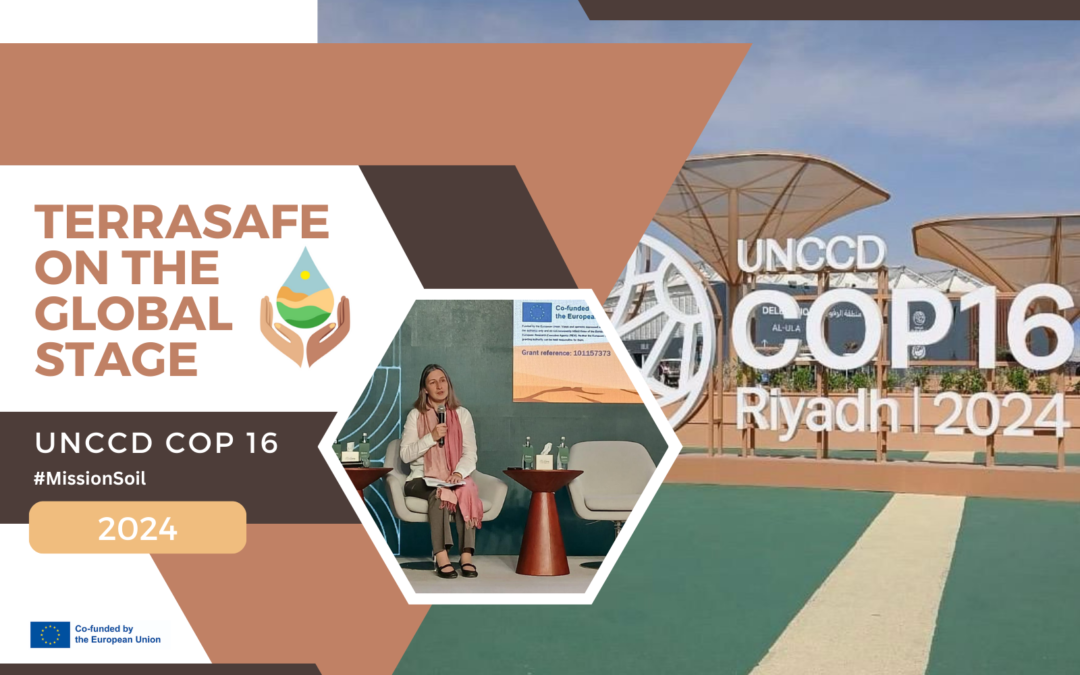
The United Nations Convention to Combat Desertification (UNCCD) held its 16th Conference of the Parties (CoP 16) in Riyadh, Saudi Arabia from 2nd to 13th December 2024. These global political discussions brought together representatives from the European Union and all 196 countries that have signed up to the UNCCD, to discuss new policy approaches to tackle desertification, land degradation and drought. Along with the political debates held in the restricted “blue” zone, the CoP also hosted multiple side events. Those events in the “green” zone were open to the public and played a vital role in raising awareness of desertification, showcasing how researchers, policymakers, the private sector and other stakeholders are working together to tackle the issue.
Prof Lindsay Stringer from the University of York and the leader of TERRASAFE’s stakeholder engagement activities, was invited to present at a public event in the green zone’s Science Oasis on 6th December. The event was convened by the Kingdom of Saudi Arabia National Centre for Meteorology and titled Innovative approaches to combat land degradation, desertification, and drought: leveraging technology and collaboration.
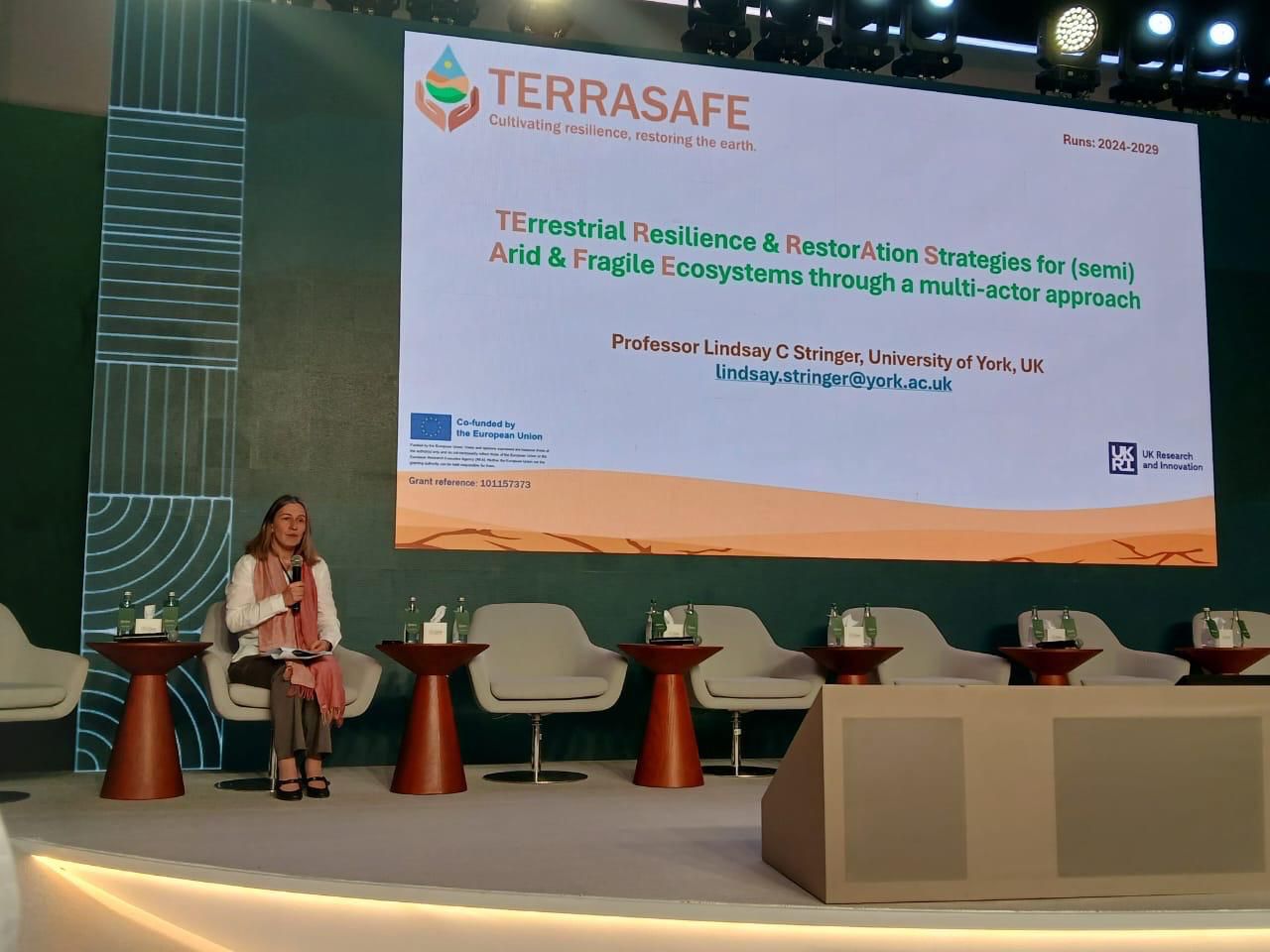
Lindsay introduced the TERRASAFE approach and underscored the importance of making sure all relevant actors are included in the development and implementation of new technologies to combat desertification. She gave an overview of the TERRASAFE actor-oriented approach that brings together different stakeholders in new desertification innovation partnerships across five pilot areas in Cyprus, Italy, Romania, Spain and Tunisia. She also introduced TERRASAFE’s innovation partners, small and medium enterprises which have developed wide-ranging technologies to help tackle the forms of desertification experienced in the pilot areas.
She explained that among the innovation partners, Agrodit offers sensors that provide real-time data for land users to track moisture, salinity and temperature and adapt their practices as necessary, while Retentis is a lignin-based hydrogel that protects plants from drought, reduces irrigation water requirements and supports the development of productive soils. Edafotec is an artificial soil made from a mix of organic and inorganic wates, giving a soil with high water retention capacity and nutrients, and Imflorestal ecochar is a mix of biochar and compost created from agricultural and forestry biomass, used in rehabilitating forest and agricultural land. Isotech is a symbiotic circular green waste management scheme which relies on shared infrastructure, existing resources and low cost, locally constructed equipment. As a shared ownership model, it allows the continuous production and free distribution of compost to farmers while also reducing waste. Lindsay informed the audience that multi-actor workshops in 2025 in each pilot area will introduce these technologies and start to get some feedback from the desertification innovation partnership stakeholders, so they can select which technologies they would like to test in their area. Results from application of the new innovations will be compared with local conventional and organic practices. Those enterprises whose technologies yield favourable results that increase resilience and demonstrate environmental effectiveness and economic viability will be supported to develop business plans for the wider adoption of their innovations.
Lindsay also introduced TERRASAFE’s sister project, MONALISA, and the projects’ respective Community of Practice and Community of Knowledge. The audience was encouraged to get in touch if they want to join these networks to share information, knowledge and practice on future participatory technology.
The session ended with a panel discussion including all the speakers in the session. The debate considered diverse technologies to tackle desertification, land degradation and drought, including the use of AI, climate-smart agricultural (CSA) practices and digital tools. Overall, these technologies play complementary roles: CSA can improve the adaptive capacity of farming systems, while digital tools like mobile apps, climate analytics data, precision irrigation technologies and remote sensing can provide information and resources to farmers that can guide land users’ decision making, helping farmers to better cope with droughts, improve yields and build long-term resilience. However, issues of access and equity need attention to ensure these benefits reach the most desertification vulnerable people, particularly where there is a lack of mobile financial services and market access. Lindsay underscored that networks and knowledge sharing were extremely important, and that engagement with technology users is needed from the outset to make sure the technologies being developed meet their needs, resources and capacities.
During her time at the CoP, Lindsay also moderated a session on Bending the curve of land degradation to achieve global environmental goals using food systems which included panellists from the Universidad Nacional de Colombia, the AEON Collective Saudi Arabia, the Instituto Potosino de Investigación Científica y Tecnológica, Mexico, King Abdullah University of Science and Technology, and the UNCCD Secretariat. She also participated as a panellist in a side event titled Promoting a new system of scientific and societal knowledge: research, education and training for an effective and contextualised fight against land degradation convened by the French Scientific Committee on Desertification, DesertNet International, the University for Peace, and the Nucleo di Ricerca sulla Desertificazione.