
In this blog, Lindsay C. Stringer MBE, Professor in Environment and Development and Dr Thomas Timberlake, Postdoctoral Research Associate, Leverhulme Centre for Anthropocene Biodiversity, share their research on community visions of the future for each of the five pilot areas of the TERRASAFE project. They reflect on how shared the aspirations are across the pilot areas, but also how each has a distinct take on how they interpret the broad themes of community, power, diverse economies, environmental action and innovation.
Desertification is a growing problem worldwide, but what needs to be done to build resilience against it? What do rural communities want to see? How do they want to live? These are some of the important questions emerging against a backdrop of other pressures in rural areas, including industrialised farming and climate change.
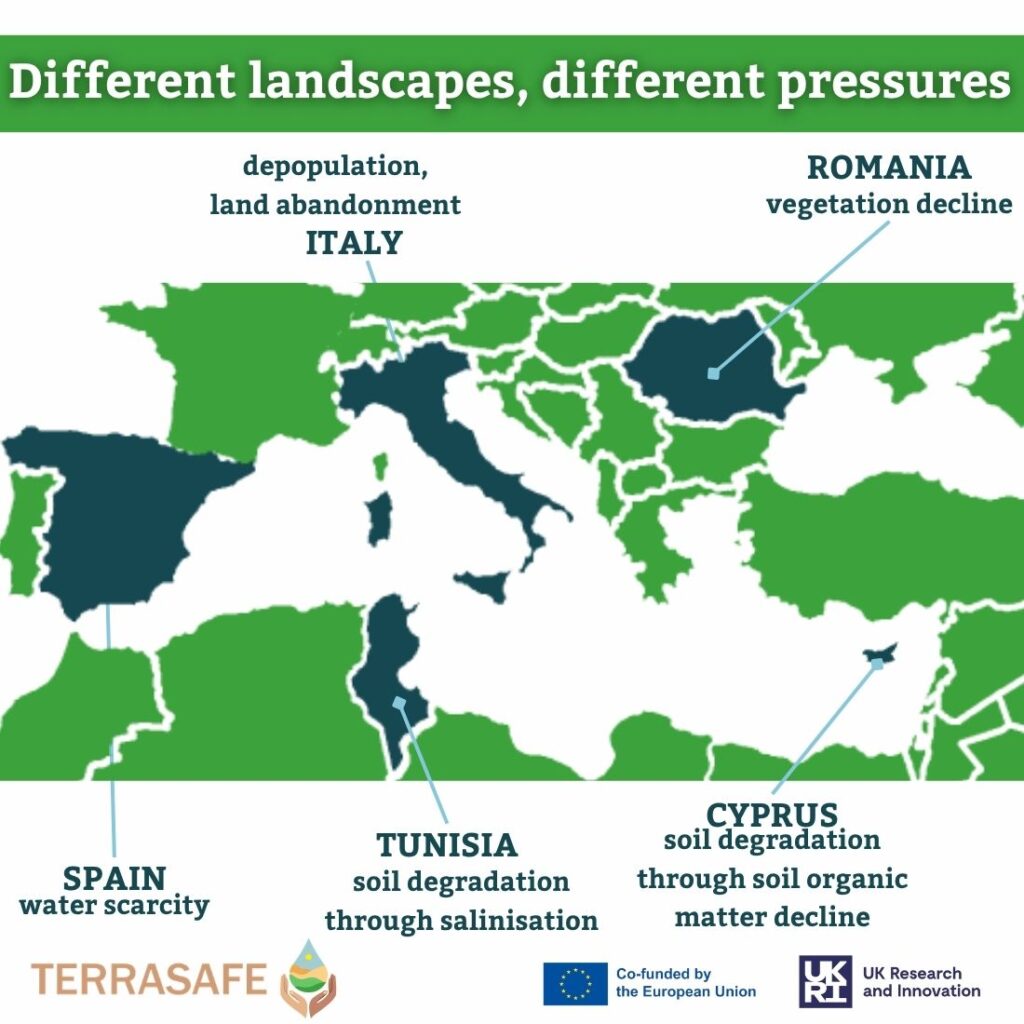
TERRASAFE has five pilot areas across Cyprus, Italy, Romania, Spain and Tunisia, each applying specific desertification solutions based on their characteristics.
Their ecological problems, economies, and social structures differ – Nefzaoua in Tunisia is an ancient oasis system built around date palm cultivation, while Cyprus combines degraded cereal lowlands with terraced mountain slopes, to give two examples.
But when we asked communities in each area to articulate a vision of what a desertification-resilient future would look like by the mid-2030s, the themes that emerged were strikingly similar.
In this blog, we’ll look at six themes that emerged while also reflecting on the distinct local conditions that push communities in different directions.
Theme one: Diverse economies
Communities consistently reject the current reality of an economic monoculture. Every community, without exception, wanted a future where livelihoods are drawn from a wider portfolio of activities. Moreover, they wanted their local economies to work with the landscape’s ecological health rather than run against it.
What kind of diversification they wanted to see differed. But the underlying logic was the same: single-sector dependence makes communities fragile, whether that dependence is on rain-fed cereals in Cyprus, date-palm monoculture in Tunisia, or oil extraction royalties in Italy.
In the Tunisian pilot, this means investment in climate-resilient crops, small livestock systems, eco-tourism, and renewable energy cooperatives. The Italian sites envisage using royalties from fossil fuels to seed investment in solar, wind, and biomass energy. The Spanish pilot sees diversification into agro-ecotourism and agri-technology services as a way to stabilise an economy currently exposed to water insecurity, alongside more drought-resilient crops.
Other areas connect economic activity to ecological restoration. For example, in Dolj, Romania, the community envisions afforestation generating rural industries in beekeeping, hunting, and eco-tourism. In SETA and MOMA, diversification will connect strongly with landscape and local identity – olive oil and handicrafts in SETA, organic produce and nature-based tourism in MOMA.
Two: Reversing depopulation
Almost all our pilot areas referenced depopulation. The Italian sites have chosen to focus on it, given its importance there. Across five of the six sites (excluding the Spanish site), rural depopulation – particularly the outmigration of young people – is both a symptom and a driver of desertification vulnerability. A landscape without people to manage it is a landscape at risk.
The Italian pilots, which are focusing on social innovations, suggested a suite of measures including tax reductions for residents in inner areas, renewed investment in public services, and efforts to attract digital nomads and smart workers who might bring income and vitality to declining villages. In both Italian sites, the community emphasised intergenerational continuity – the passing on of land-management knowledge and a sense of place. This reflects the severity of rural demographic decline in our pilot, where populations have halved since the 1960s.
Communities want good amenities, infrastructure, and services to offer families and young people – enough to persuade them to stay or to attract them to rural areas.
In Tunisia, the demographic challenge has another dimension – gender inequality. Tunisian stakeholders see the empowerment of women and marginalised groups as key to regenerating the landscape. This reflects both the different political context in Tunisia and the greater depth of economic marginalisation there compared with the EU pilot areas.
Three: Water security
Water management is a constant theme across all communities. Yet each area faces specific water security challenges, with the pilot areas in Spain, Cyprus and Tunisia the most pressing.
The Spanish site faces the most acute structural water problem. The area depends on water transferred from other Spanish regions and faces chronic scarcity that is worsening under climate change. The community unsurprisingly would like to see advanced irrigation, water recycling, and investment in hydraulic systems.
In Cyprus’s pilot area, stakeholders envision optimal management of two existing small dams, groundwater recharge via check dams across streambeds, rainwater harvesting at the field, household, and community level, and efficient reuse of treated wastewater.
In Tunisia, the community emphasised equity and the efficiency of water management. Their vision includes efficient irrigation systems and water recycling alongside community-governed water management – a recognition that technical solutions must be embedded in changed governance arrangements. They see the oasis system as a distinct socio-ecological unit deserving special legal protection.
Four: Soil health and landscape restoration
Across all five sites, a restored, healthy, and productive landscape is the environmental centrepiece of the communities’ vision. However, the specific ecological priorities differ in ways that reflect some of the areas primary degradation challenges.
Cyprus focuses heavily on soil organic matter and soil care, including composting, manure recycling, organic substrate production, and circular-economy nutrient management, all explicitly linked to government incentives and local composting facilities. The vision includes tree planting and the protection of native species alongside policies that reflect a respect for nature.
Romania’s vision is dominated by agroforestry and afforestation, not surprising given that wind erosion on sandy plains is the primary driver of desertification in Dolj, and trees can help stabilise and secure the soil. Silvopastoral systems, combining trees, crops, and pastures, will protect soil, conserve water, and create new microclimates.
In one Italian site, low-energy, sustainable agroforestry systems and regenerative farming methods that enhance soil fertility and ecosystem services are a priority, underpinning agricultural improvement and economic/community regeneration.
In Nefzaoua, Tunisia, where soil salinisation is the primary problem, improved irrigation practices and the restoration of native oasis vegetation take priority.
Five: Better governance and participation
A consistent undercurrent in all six visions is a desire for better governance – more transparent, more participatory, and more aligned with the needs of those who actually manage the land. This is expressed differently across institutional contexts, but the underlying aspiration is shared.
In the European sites, better coordination, policies that benefit land managers and greater participatory decision-making all arise. In Cyprus, negative aspects of community relationships also emerged. Stakeholders wanted better communication between farmers and neighbours regarding practices such as manure application to reduce conflict and build trust.
Romania frames the governance aspiration partly in terms of fairness: legislation that is clear, fair, and beneficial to those who manage or rehabilitate degraded lands, with administrative procedures accessible regardless of education or social class. This reflects a context in which bureaucratic barriers are perceived as a significant constraint on community action.
The Tunisian site’s governance vision is the most community-centred: local organisations, cooperatives, and farmers’ associations would take the lead in managing water, conserving land, and coordinating adaptation strategies, with the state providing an enabling framework. This bottom-up model reflects the strength of cooperative traditions in the oasis system.
The Spanish pilot is notable for explicitly including the connection between urban and rural populations as an environmental challenge. The vision calls for communication campaigns that help urban consumers understand where their food comes from and what it costs to produce sustainably. Stakeholders also want greater social and political backing to adapt to environmental challenges, underscoring the importance of the national government. Nevertheless, they still want to remain central actors in environmental governance.
Six: Education and cultural identity
All six communities, in different ways, touched on the idea of a future in which environmental awareness and land-management knowledge are more deeply embedded in local culture.
Italy is facing acute cultural and environmental challenges and sees preserving and renewing territorial identity as a way to address depopulation and fragmentation.
Cyprus emphasises technical knowledge transfer: farmers and community members gaining access to advice on composting, organic substrates, and circular-economy practices. Romania frames civic education as the key mechanism for reducing destructive behaviours such as illegal logging and the degradation of fields, starting in schools.
Tunisia’s emphasis on vocational training and education for youth and women is more explicitly developmental, seeking to equip marginalised groups with the skills to participate in a diversifying economy.
Making it happen
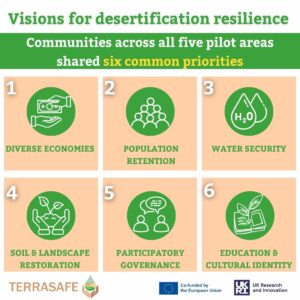 The six communities share a vision that reconnects economic activity, social life, and land management. Diversified economies, retained and retrained populations, restored landscapes, local facilities and more participatory governance appear in every vision in different ways.
The aspiration to leave a healthy landscape and thriving communities for future generations is perhaps the deepest shared value.
The visions diverge depending on local economic, political and social contexts and, as a connected issue, the primary desertification challenge in each area. Water scarcity and infrastructure are paramount in Cyprus and Spain; soil salinisation and ecosystem restoration are central in Tunisia; agroforestry and afforestation to control wind erosion dominate in Romania; depopulation and territorial identity are the primary frames in Italy.
The aspirations within these visions are both ambitious and varied. We hope that, through the shared learnings and discussions taking place within TERRASAFE, the communities will be able to create a supportive context to enact at least some of them in the near future.