
Introducing our sister project: MONALISA
The MONALISA project is a ‘sister’ project to TERRASAFE, which means we will collaborate closely to achieve our shared goals.
MONALISA aims to prevent and reverse land degradation and desertification (LDD) by promoting innovative, tailored solutions with proven socio-economic and environmental benefits. It adopts a transdisciplinary approach, integrating scientific and local knowledge through social learning spaces involving diverse stakeholders and researchers. The project spans six Mediterranean case studies across Italy, Spain, Greece, Tunisia and Palestine, addressing varying aridity levels.
Key solutions include adaptive grazing systems, microbial-based biofertilizers, conservation agriculture, ecological restoration, water harvesting, and wastewater reuse in agriculture. A core output is a multi-modular, web-based Decision Support System leveraging remote sensing and AI. MONALISA also explores business opportunities, cost-benefit analyses, and investment promotion to foster sustainable, environmentally-friendly solutions and support economic growth in European and Mediterranean drylands.
MONALISA Overall Objectives
- Identify, showcase, and promote the expansion of innovative, tailored, socio-economic, and environmentally effective solutions to prevent and reverse Land Degradation and Desertification (LDD).
- Provide an effective methodological framework to assess and monitor LDD risk in European and Mediterranean drylands at different spatial scales.
MONALISA Overall Objectives
- Identify, showcase, and promote the expansion of innovative, tailored, socio-economic, and environmentally effective solutions to prevent and reverse Land Degradation and Desertification (LDD).
- Provide an effective methodological framework to assess and monitor LDD risk in European and Mediterranean drylands at different spatial scales.
MONALISA Case Studies
The development of the MONALISA project and solutions will be carried out in 6 Mediterranean Case Studies – Los Pedroches in Spain; Médenine in Tunisia; Berchidda-Monti and Alta Murgia Park in Italy; Asterousia in Greece and Beit Dajan in Palestine.

Médenine in Tunisia. Photo credit: MONALISA
MONALISA Community of Knowledge
The MONALISA project is proud to introduce its Community of Knowledge (KC), a dynamic initiative fostering collaboration and innovation to tackle land degradation and desertification (LDD). Led by ISPRA, MONALISA will build a Community of Knowledge to facilitate the dissemination and use of results. The Community is a platform to unite key experts – from researchers to policymakers and practitioners – in advancing sustainable solutions for LDD. Activities include annual meetings, open calls for young researchers, quarterly news updates, and biannual Café Talks, facilitating dialogues across scientific, technical, and public domains. With the engagement envisaged of more than 300 members, the KC will promote knowledge exchange, networking and the integration of project results, particularly in the Mediterranean and European regions. Together, we aim to create a lasting impact by scaling out project outcomes and influencing LDD-related policies.
Get in touch with MONALISA
MONALISA Community of Knowledge coordinator: monalisa_kc@isprambiente.it
MONALISA Consortium
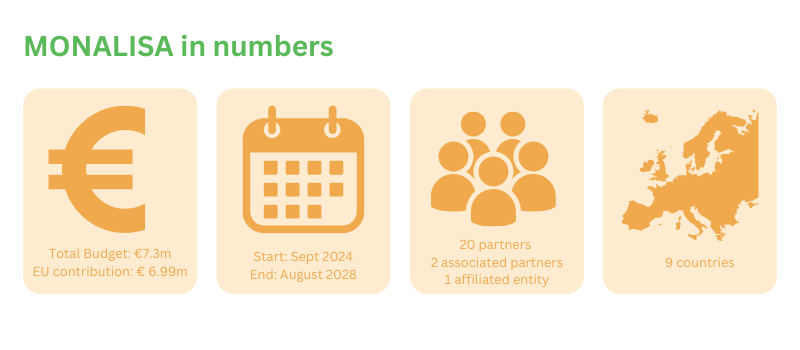
MONALISA consortium consists of 20 partners, 2 associated partners and 1 affiliated entity: Universita Degli Studi Di Sassari (UNISS); Universita Degli Studi Di Roma La Sapienza (Sapienza); Panepistimio Kritis (UoC); Centro De Investigacion Ecologica Y Aplicaciones Forestales (CREAF); Hellenic Society For The Protection Of Nature (HSPN); Ethniko Kentro Erevnas Kai Technologikis Anaptyxis (CERTH); Istituto Superiore Per La Protezione E La Ricerca Ambientale (ISPRA); Consiglio Nazionale Delle Ricerche (CNR); Institut Des Regions Arides (IRA); Commissariat Regional Au Developpement Agricole De Medenine (CRDA) (AE); Centre International De Hautes Etudes Agronomiques Mediterraneennes (CIHEAM); Agricolus Agritech Spain Sl (Agricolus); Fondazione Medes (MEDES); We World-Gvc Organizzazione Non Lucrativa Di Utilita’ Sociale (WeWorld); Aarhus Universitet (AU); Asociacion Adroches Para El Desarrollo Rural De La Comarca De Los Pedroches (ADROCHES); Universitatea Din Bucuresti (UniBuc); Inosens DOO Novi Sad (InoSens); Cooperativa Produttori Arborea – Societa Agricola (CoopArb); Ente Parco Nazionale Alta Murgia (AltaMurgia); Reseau Pour La Recherche Internationale Sur La Desertification (DNI); Universitat Basel (UNIBASE) (AP); Universite De Geneve (UNIGE) (AP).
Related project: LandShift
LandShift is an EU-funded Horizon Europe project that develops innovative land-use strategies to balance climate change mitigation, sustainable food and biomass production, and biodiversity protection. Through five Living Spaces across France, Greece, Italy, Poland, and Ukraine, the project co-creates nature-based solutions with local communities and decision-makers to achieve climate-resilient land management, aligning with the values of the New European Bauhaus.
Related project: AgroTech Hub Cluster
AgroTech Hub Cluster is a joint initiative bringing together Horizon Europe projects working at the intersection of agriculture, climate resilience, digital innovation, sustainable land management, and bioeconomy. With this collaboration, we will create joint efforts towards knowledge exchange with related initiatives, joint dissemination activities, and engage in wider discussions on how data, technology, and community-led approaches can support more sustainable and climate-resilient land-use practices across Europe and North Africa.

